
Maintenance Team 62474
IEC 62474 Material declaration for products of and for the electrotechnical industry
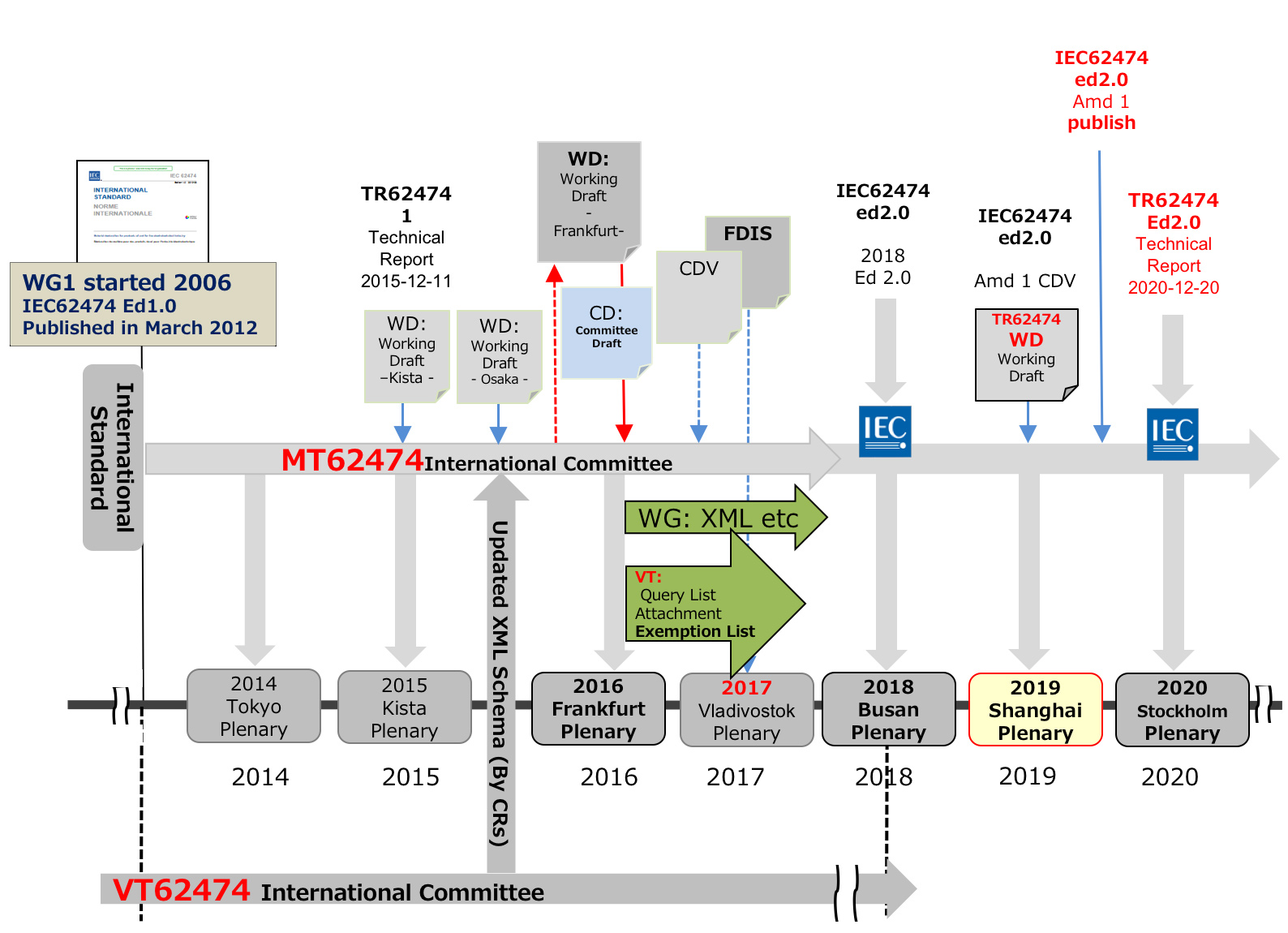
Publication of IEC 62474 Edition 2 in December 2018
History of IEC 62474
The first edition of IEC 62474 was published in 2012. For the first time, an international Standard spelled out the requirements for reporting substances in electrical and electronic (EE) products throughout the supply chain, thus helping industry to conform to national or regional legislation, and to implement ecodesign processes.
IEC 62474 has replaced national or regional standards, e.g. the Joint Industry Guide (JIG-101) and the Japanese Green Procurement Survey Standardization Initiative (JGPSSI).
The second edition of IEC 62474 was published in November 2018, in response to stakeholder requests from inside and outside the EE industry. IEC 62474 provides information on what to report and how to report it, including a separate mechanism for the exchange of data down the supply chain. The new edition enables users to employ two different methods for declaring substances. IEC 62474 comes with a validated open database, which includes a list of substances, substance groups and common material classes. It now also includes exemption lists from national and regional government legislation such as EU ROHS and China RoHS.
The IEC 62474:2018 standard introduces several new and revised capabilities to the International Material Declaration Standard. The new capabilities are based on emerging regulatory requirements, user feedback, and the needs of a broad range of industries. It provides significant flexibility for suppliers to provide material declaration information while ensuring that critical information for downstream manufacturers to assess product compliance is always available. The Data Exchange Format now includes a new Declaration for Compliance module and additional support for EU REACH compliance and the upcoming EU Substance of Concern in Products (SCIP) database. The changes were also intended to make the standard useful to a broad range of industries and different stages in the supply chain given the intertwined nature of global supply chains. .
Purpose of IEC 62474
IEC 62474 establishes the requirements for reporting the substances and materials included in electronic and electrical products. It also facilitates the transfer and processing of this data by defining a common data format which applies to exchanges in the supply chain. It can be used by other industries than the EE sector.
Work activity
2020 plan:
Face to face meeting: Jan 28-31, 2020
Publication of the Amd.1
Publication of IEC 62474 ed2.0 Amendement 1
Publication of TR 62474-1 ed2.0
Long term: 3/5 years
Publish a Dual Logo ISO/IEC 62474
MT 62474 Efforts (WG1)
Summary of standard requirement
IEC 62474 is an International Standard on material declaration. It includes declaration requirements, an XML-schema for data exchange format, and a set of Internationally recognized lists for the electrotechnical industry (declarable substances, material classes, and exemptions). The contents of the standard that may need to be updated regularly are provided in an online database which is maintained by an International validation team.
The material and substance information in the declaration are organized into declaration modules referred to as “sectionals”. A hierarchical data representation of the “Product” type in the XML schema was shown in the figure below. The declaration modules (types of declarations) that may be included are:
• Declaration for Compliance;
• Composition Declaration;
• Material Class Declaration; and
• Query Statement Declarations (represented by Query Lists)
A material declaration that conforms to IEC 62474:2018 needs to include at least a Declaration for Compliance or a Composition Declaration (it may also contain both). The Composition Declaration is used by a supplier (responder) to provide a hierarchical declaration of substances within product parts and materials that make up the product. The Declaration for Compliance is a simplified true/false declaration against each entry in a Declarable Substance List (DSL), indicating whether the declarable substance (DS) or declarable substance group (DSG) is present in the product above threshold.

Associated databases/tools
The IEC database is available on the IEC website at http://std.iec.ch/iec62474
Note: For a declaration to conform to the IEC 62474 data exchange format, it needs to meet the declaration requirements specified in the IEC 62474:2018 document (Clause 4), the format requirements specified in the IEC 62474 XML schema and the additional requirements in the Developer’s Table.
Laws/regulations quoting IEC 62474
IEC 62474 is referenced in other IEC and European standards that are applicable to regulations, including EN 50581/IEC 63000 (restricted substance technical documentation) and EN 45552 (Critical Raw Material).
Benefits of IEC 62474
Governments
Government Authorities that issue substance restriction regulations need to have economic methods for regulated entities to obtain substance data to conform to these requirements that allow for international trade. IEC standards such as IEC 62474 are recognized by the World Trade Organization (WTO). This means that Government Authorities can adopt IEC 62474 to provide an economically feasible tool to its resident companies to achieve the substance restrictions, and be assured that such rules facilitate international trade and are in conformance with WTO standards.
Also, restricted substance regulations usually include exemptions for certain products based on available technology or other issues. Exemptions are dynamic and change often based on changes to technology and products. This requires Government resources to evaluate exemptions from product suppliers and exemptions issued by other Government Authorities to determine suitability. Governments may not be able to update exemptions based on a direct referral to exemptions issued by other Governments. This results in time lags to do analyses and grant updated exemptions, which can have negative impacts on local economies.
IEC 62474 now allows Government Authorities to adopt restrictions from other Government Authorities by referencing the international IEC 62474 database. Since IEC 62474 maintains current exemption lists, Governments may rely on this database without additional resources or time.
National standards bodies
My heading is awesome
IEC 62474 gives manufacturers standardized solutions for obtaining information to determine its conformance status to restricted substance regulations in all countries where they operate and sell their products. IEC 62474 also gives manufacturers the tools to obtain substance data through its supply chain without additional costs or causing unfair advantages for large organizations or organizations that purchase high volumes of parts and materials.
Since IEC 62474 specifies clear expectations for anyone selling into the EE sector, it can be expected to get better quality of data from the supply chain.
Suppliers
IEC 62474 allows suppliers to know what it needs to report and gives a standardized method to share that data to its customers. This reduces cost needed to meet customer requirements and Government regulations, and assures global market access.
Investors
Investors can be assured that organizations that meet IEC 62474 have reduced risk of interruptions or loss of market access, since they are obtaining all needed data to determine restricted substance conformance status. Socially conscious investors know that organizations adopting IEC 62474 have methods to do environmentally conscious design for its products.
Testing organizations
IT tool providers
IEC 62474 gives IT tool providers standardized design criteria for the reporting of material and substance data, and reduces the number of alternative or country-specific designs needed. This reduces cost and improves quality of the IT tools.
Other non-governmental organizations
Many non-EE industries have the need to report substance and material data. These industries may reference IEC 62474 to exchange data and focus their efforts on maintaining a sector-specific list of substances to report, since the IEC 62474 data exchange method allows for specification of any list by list Identification. This reduces effort and helps to promote global trade.